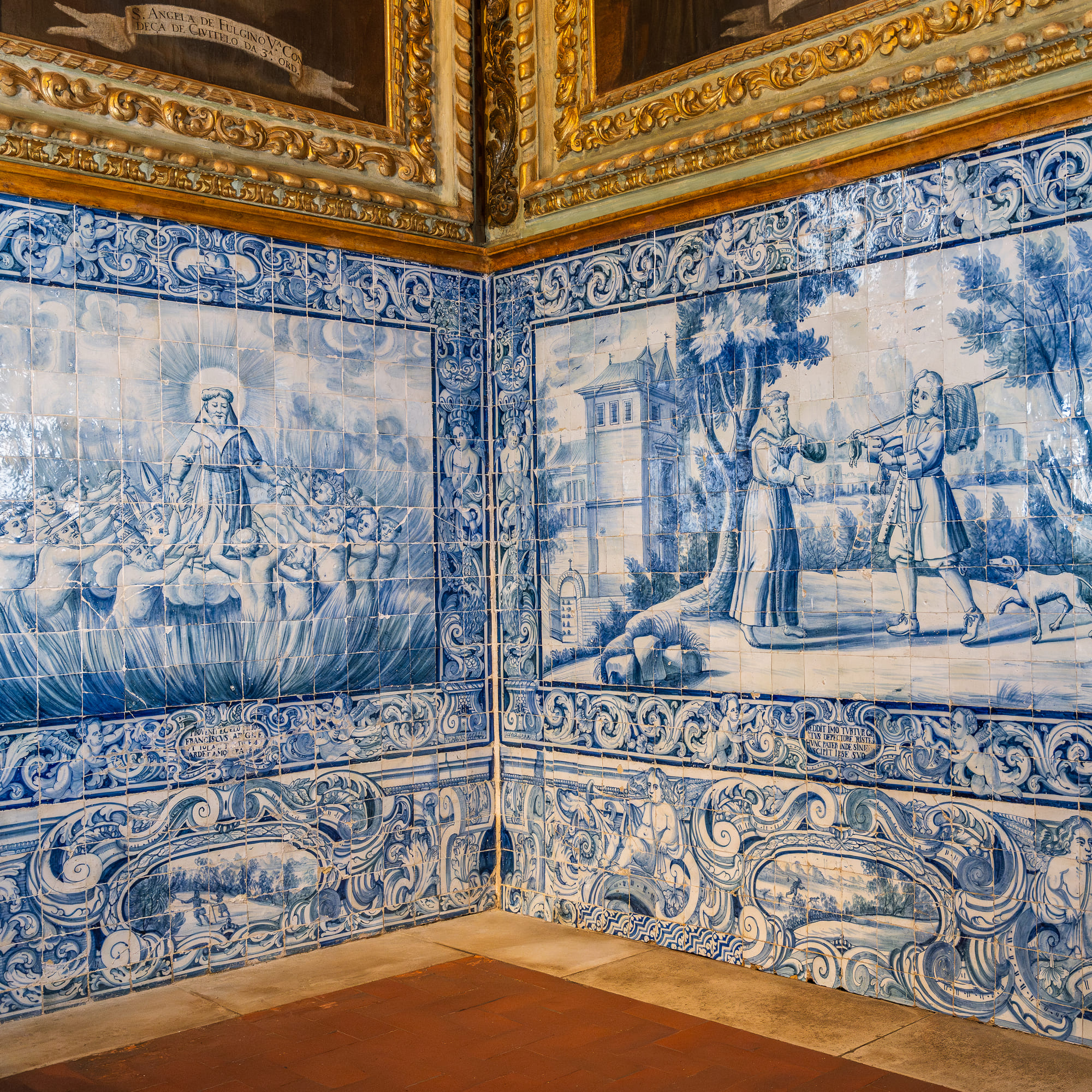
Attached to the Church of the Convent of Nossa Senhora de Jesus do Sítio (17th century), on Avenida Dom Afonso Henriques, is the Chapel of the Third Order of São Francisco, considered a masterpiece of the Portuguese Baroque, completely covered in gilded wood carvings and magnificent tile panels. With the Franciscan Hagiography as its strong point, the decorative art of the Golden Chapel, in a theatrical setting, transposes, to the naked eye, a common language in the evocation of the remarkable scenes of the life of St. Francis of Assisi through the dialogue between tile and canvas painting, topped by gilded woodwork.
The chapel has undergone structural and roof rehabilitation, until it can receive a significant conservation and restoration campaign in 2020 and 2021 – promoted by the Santa Casa da Misericórdia de Santarém and financed by the Rainha D. Leonor Fund of the Santa Casa da Misericórdia de Lisboa in partnership with the Union of Portuguese Misericórdias. The work was inaugurated on May 31, 2021, and the Chapel is accessible by visiting the Church of Jesus Christ.
The Church of Santa Maria da Graça, also known as Igreja da Graça, is located in Largo Pedro Álvares Cabral (also known as Largo da Graça), right in the historic center of the city of Santarém. Having secured the patronage of several important members of the Scalabitan nobility, including the first Counts of Ourém, João Afonso Telo de Meneses and his wife Guiomar de Vilalobos, the Augustinian friars settled in Santarém in 1376 and work began on building the church in 1380, which was finally completed in the second quarter of the 15th century.
During the 17th and 18th centuries, various decorations were made to the altars and chapels, including paintings, tile decoration on the walls of the Chapel of the Lord of the Steps and altarpieces. Of particular note is the 18th century tile panel depicting St. John the Baptist between St. Rita and St. Francis, located in the right wing chapel.
The temple’s current interior appearance is the result of a renovation carried out by the former DGEMN, in which most of the dissonant elements of the Gothic imagery were removed from all the decoration on this chapel.
The five commercial advertising panels by Luis Antonio Ferreira (1806-1873), better known as “Ferreira das Tabuletas”, can be found in Rua Capelo e Ivens.
Luís António Ferreira, or Ferreira das Tabuleta, was a tile painter from the late 19th century, trained at the Fábrica do Rato, who left extremely creative works, both simple and vibrant.
He is credited with several examples throughout the country of equal importance, most notably the interior of the Cervejaria Trindade in Lisbon.
In addition to their decorative function, the panels featured here are part of an intelligent set of advertisements. The tile panels of “Ferreira das Tabuletas” are a calling card to learn more about a unique figure in the history of art in Portugal, whose vibrant energy still captivates us today with its resounding quality.
The Church of Nossa Senhora de Marvila (a 12th century building) is located in the historic center, next to the square formerly known as Praça Velha, and belongs to one of the oldest parishes in the city.
Inside, the polychrome tiles from the first half of the 17th century stand out, earning it the name “cathedral of 17th century tiles” in Portugal. In this way, the church is a small museum of the history of Portuguese tile art.
The church is the largest 17th-century collection in Portugal, with an area of 1,200m2, corresponding to more than 65,000 ceramic tiles. The largest tile pattern, known as the “rich pattern of Marvila”, is used on the upper part of the nave walls.
The Church of Misericórdia de Santarém, also known as the Church of Nossa Senhora da Visitação, in the Mannerist and Baroque style, with a church-hall plan, is located in the historic center, more specifically in Rua 1º de Dezembro.
Inserted in the building of the Misericórdia Church, the Definitory Room (where the deliberative council on religious matters meets), or consistory, has a magnificent array of neoclassical tiles, which run the length of the room with plant and decorative motifs, in olive green and manganese purple, centered by round tiles in blue on a white background, representing the Corporal Works of Misericórdia, illustrated with scenes from everyday life. Placed without sequential order, starting from the entrance, we have the following representations: “burying the dead”, “redeeming captives”, “visiting the sick”, “visiting prisoners”, “giving drink to the thirsty”, “feeding the hungry”, “giving lodging to pilgrims” and “clothing the naked”.
The ensemble is attributed to the painter Francisco Jorge da Costa, active until the end of the 18th century, whose works, initially closer to rococo and then neoclassical, bear witness to the panorama of Portuguese tilework at the end of the century.
The church and the adjoining building housed the headquarters of the Santa Casa da Misericórdia until it was transferred to the Convento de Nossa Senhora de Jesus do Sítio. Both have been classified as National Monuments since 1922.
The Palácio dos Meneses, also known as the Eugénio Silva Palace or Paços do Concelho, is a magnificent example of 17th and 18th century manor house architecture.
The Palace, classified as a Property of Public Interest in 1951, has been the current seat of the Santarém City Council since 1956, and stands on Largo do Município. Until the mid to late 18th century, it was the property and residence of the Telles de Meneses family.
On the second floor of the building, in the room that currently precedes the Sessions Room, called the Councillors’ Room, we can admire a magnificent set of tile panels that are part of an 18th century aesthetic and represent ten virtues: respect, prudence, piety, understanding, unity, abundance, zeal, providence, silence and justice.
The tiles, due to their undoubted beauty, still attract the attention of those who pass through the room.
Dating from 1930 and designed by the architect Cassiano Branco (1897-1970), it replaced the open-air market that had survived for centuries in Praça Visconde Serra do Pilar, known as Praça Velha. It is an example of iron architecture combined with a cultural historical model, giving it a “slight chalet air”.
Classified as a Property of Public Interest in 2012, the Municipal Market proudly displays a valuable collection of naturalistic tiles depicting the Ribatejo, laid between 1932 and 1936 and from the Sacavém Crockery Factory. On its walls, tile art proudly depicts the city’s heritage and monuments, national landmarks, representations of agricultural work and various experiences of the people of Escalabia and the daily life of the Ribatejo region at the beginning of the 20th century. Beginning in the summer of 2019, a series of refurbishment works at the Santarém Municipal Market will preserve and revitalize this landmark of the city’s tile heritage.
The Episcopal Palace, also known as the Jesuit College or Seminary Church, is located in the historic center of the city of Santarém, more specifically in Praça Sá da Bandeira.
The magnificent set of tiles in the Patriarchal Seminary is a faithful and valuable testimony to the prominent role played by tiles in Portugal.
We can say with certainty that the convent area has an extremely rich collection of Baroque tiles depicting hunts, port and genre scenes, some of which have been truncated by the opening of new openings, especially the Franciscan-themed one next to the refectory, as well as the neoclassical Atosu room, which was built like other grandiose rooms in the Colleges of the Society of Jesus.
The church was elevated to the role of Cathedral and Episcopal Palace of the Diocese of Santarém in 1975, when the diocese was created.
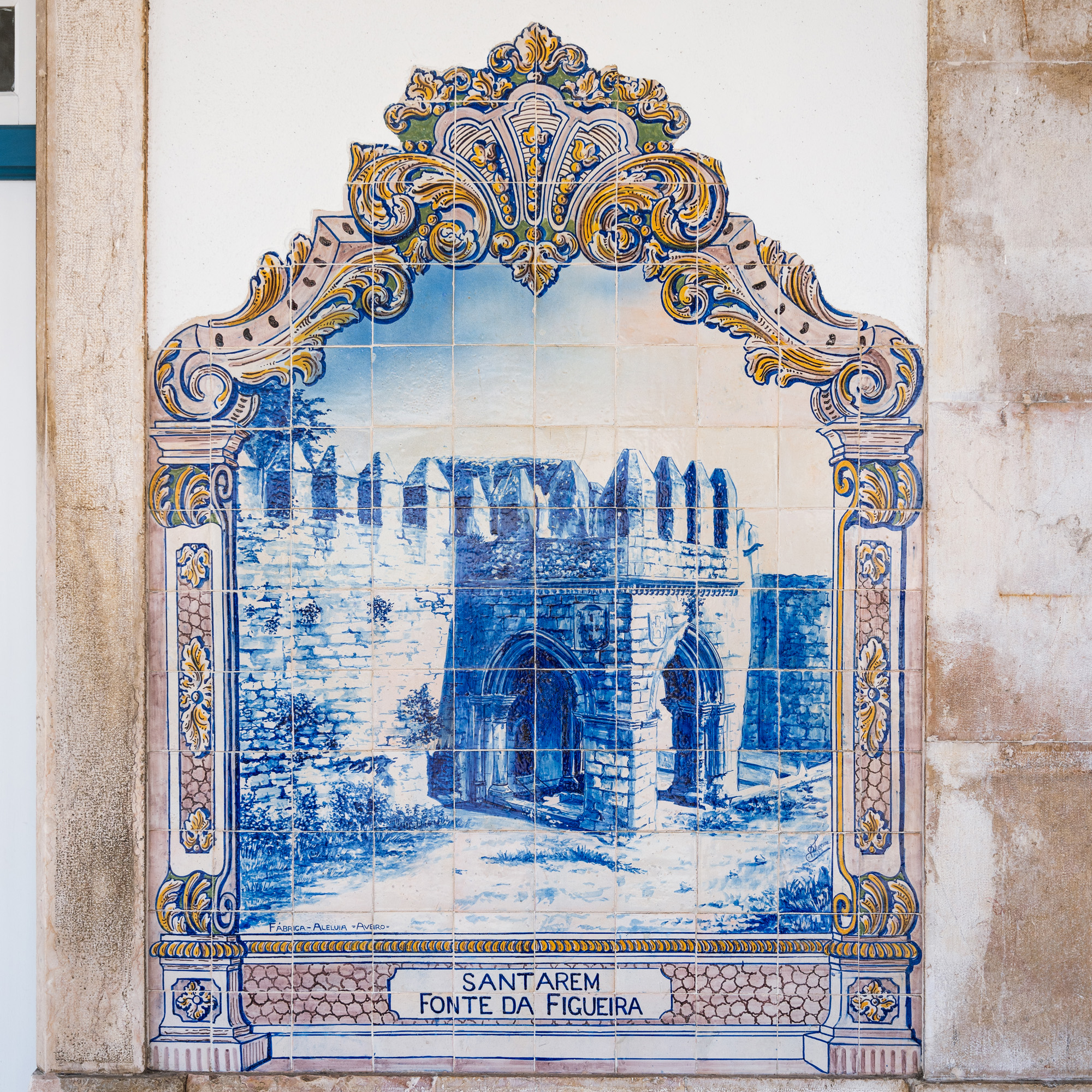
The Santarém CP station, whose line dates back to 1861, is located in Largo da Estação, on the Ribeira de Santarém. The passenger building, completed in 1927, features an original set of tile panels that make up its rear façade and invite us to immerse ourselves in the culture and customs of the city, welcoming us in shades of blue and white as we get off the train.
According to the Portuguese writer Agustina Bessa-Luís (1922-2019), the tiles at Santarém Station represent, with distinction, the set of tiles scattered around Portuguese stations which, at some stops, are like magnificent picture postcards of the region. In her own words, the Santarém station is home to “some of the best tiles (…) very vivid, very honest with realism, with cattle fairs and the rush of farmers rounding up cattle.”
The station is decorated with 18 magnificent and imposing tile panels produced by the Aleluia Factory in Aveiro, which depict Ribatejo traditions, agricultural work and monuments from Santarém, Golegã and Ourém with thrilling perfection.
If you have any questions. Do not hesitate to contact us.
Town Hall: 243 304 200
(Call to the national fixed network)
Tourist Office: 243 304 437
(Call to the national fixed network)
GNR: 243 300 091
(Call to the national fixed network)
Volunteer Firefighters: 243 377 900
(Call to the national fixed network)